He Knew Your Name Before He Knew Your Door: The Paperboy America Left Behind
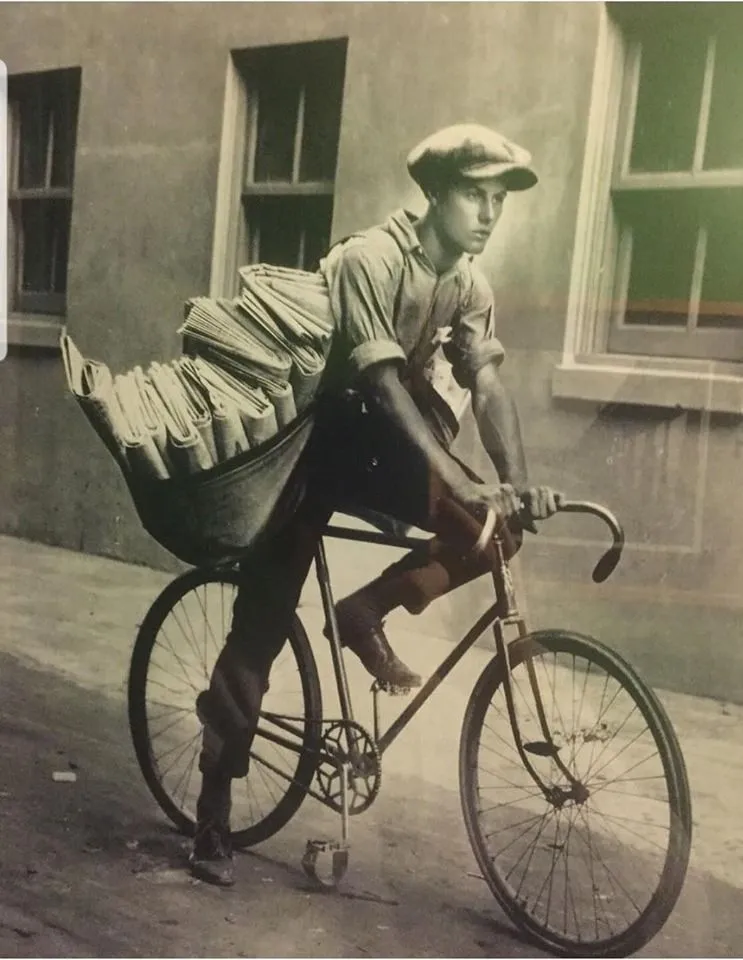
Photo: vintage paperboy bicycle delivering newspaper suburban neighborhood 1950s, via i.pinimg.com
Somewhere around 5:30 in the morning, before most of your neighborhood had cracked an eyelid, a kid on a bicycle was already doing the math. Forty-seven houses. Forty-seven papers. And somewhere on Elm Street, the Hendersons still hadn't paid for the last two weeks.
 Photo: Elm Street, via images.squarespace-cdn.com
That was the paperboy. Not an algorithm. Not a fulfillment center. A person — usually a teenager working toward something, a used guitar or a first car — who physically connected your home to the wider world every single morning.
We didn't think much about it then. Now it's almost impossible to imagine.
The Route Was More Than a Route
At its peak in the mid-20th century, newspaper delivery routes employed hundreds of thousands of American kids. The industry didn't just move information — it built character, taught responsibility, and created a web of low-stakes but genuine human relationships that stitched neighborhoods together in quiet, unremarkable ways.
The paperboy knew things. He knew that Mr. Patterson wanted his paper on the top step, not the bottom, because of his bad knee. He knew the Garcias had a dog that needed a gentle toss from the sidewalk. He knew which houses were dark at 6 a.m. and which ones had a light on and a smell of coffee drifting through a screen door.
 Photo: Garcias, via apellido.vukki.net
 Photo: Patterson, via cdn.cloud.pattersoncompanies.com
And once a month, he knocked. Not to sell anything. Not to upsell a premium tier. Just to collect. That monthly collection ritual — a kid at your door, a few dollars changing hands, maybe a tip if you were feeling generous — was a tiny but real moment of community accountability. You saw his face. He saw yours. The transaction had a human witness on both ends.
When Delivery Became a Data Point
Today, your news subscription lives somewhere between a credit card statement and a forgotten browser tab. You signed up online in under two minutes, probably during a free trial that auto-converted while you weren't watching. Your "delivery" is a notification on your phone, curated by an engagement algorithm that decided — based on your click history and demographic profile — what you probably want to see first.
Nobody knocked. Nobody collected. Nobody knows if the Hendersons are caught up.
The mechanics of cancellation alone tell you everything about how the relationship changed. Signing up takes ninety seconds. Canceling often requires a phone call to a retention specialist trained to keep you on the line, offer you three discounted months, and ask you — twice — if you're really sure. The asymmetry is deliberate. The old paperboy couldn't have dreamed of that kind of leverage.
What the Shift Actually Cost
It's tempting to frame this as pure progress. Digital delivery is faster, cheaper, more efficient. You can access a thousand publications from a single device. The environmental footprint is smaller. On paper — so to speak — it's a straight upgrade.
But something real disappeared when the human layer got stripped out of the transaction.
The paperboy was, in a small but meaningful way, a community institution. His route was a physical map of belonging. When he delivered to your door, he was also delivering proof that someone had thought about your specific address that morning. The paper didn't just arrive — it was brought.
There's also the question of what those routes did for the kids running them. A paper route was one of the earliest and most effective financial education programs America ever accidentally invented. You managed a customer list. You handled collections. You learned that if you didn't show up in a snowstorm, you heard about it. The accountability was immediate and personal.
Today, a teenager's first experience with "earning" often looks like gig-economy micro-tasks or social media monetization — systems designed by corporations to extract labor with minimum friction and zero mentorship. The paperboy had a district manager who showed up once a month and told you straight if your folding technique was sloppy.
The Algorithm Doesn't Know Your Steps
Here's the thing about the shift from physical to digital that rarely gets discussed: it didn't just change how news travels. It changed who controls the relationship.
When a kid delivered your paper, you were the customer and he was the service provider. The dynamic was clear and the power was relatively balanced. If the paper kept landing in the bushes, you said something. He adjusted. That feedback loop was immediate, local, and human.
Now, the platform decides what you see, when you see it, and how prominently it appears. The algorithm isn't delivering news to you — it's delivering you to advertisers, using news as the vehicle. You're not the customer anymore. You're the product. And no amount of feedback to a support chatbot is going to change where the paper lands.
A Small Thing That Was Never Really Small
Nobody is suggesting we go back to a world of folded broadsheets and bicycle routes. That ship sailed with the classified ad section.
But it's worth pausing on what we normalized when we let the human layer of even the most routine transactions disappear. The paperboy wasn't just delivering news. He was a thread in a fabric — the kind of fabric that makes neighborhoods feel like places rather than zip codes.
When he knocked once and you answered, something passed between two people that no push notification has ever quite replicated.
You knew his name. He knew yours. And somehow, that mattered more than either of you realized at the time.