The Shoebox Archives: When Every Family Photo Was Worth Keeping
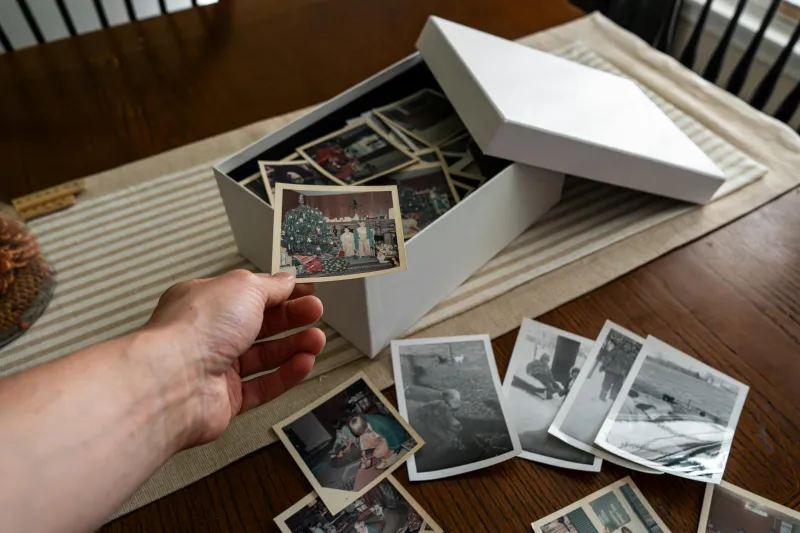
In the back of Janet Thompson's bedroom closet sits a faded Kinney shoe box that holds thirty years of family history. Inside, 247 carefully preserved photographs tell the story of her children's childhoods: first steps, birthday parties, Christmas mornings, and summer vacations. Each image was chosen deliberately, printed intentionally, and saved purposefully.
 Photo: Janet Thompson, via www.anderson-funeral-directors.co.uk
Meanwhile, her daughter keeps 47,000 photos on her iPhone.
The contrast reveals one of the most dramatic shifts in how American families document their lives. We've moved from scarcity to abundance, from intentional to automatic, from precious to disposable. But in gaining infinite storage, have we lost something essential about how we remember?
When Photography Required Planning
Before digital cameras transformed every moment into a potential photograph, taking pictures required forethought. A roll of 24 or 36 exposures cost $3-5, plus another $8-12 for developing. Each click of the shutter represented a financial decision.
"You didn't waste shots on blurry pictures or random moments," recalls Robert Chen, who documented his family's life throughout the 1980s. "You waited for the right moment, made sure everyone was looking, and hoped you got it right the first time."
 Photo: Robert Chen, via www.wfmt.com
This scarcity created a different relationship with photography. Families planned photo sessions around important events. They gathered everyone together, adjusted the lighting, and took one or two careful shots. The anticipation of seeing the results — waiting days or weeks for film development — added weight to each image.
Holidays and special occasions became natural focal points for photography, creating a rhythm of documentation that followed life's most meaningful moments. The family camera came out for birthdays, graduations, and vacations, but stayed tucked away during ordinary days.
The Shoebox Museum
Once developed, photographs entered a careful curation process. Families sorted through prints, discarding the obviously failed shots and selecting the best images for preservation. The chosen photographs found their way into albums, frames, or — most commonly — shoeboxes that served as informal family archives.
These shoeboxes became treasure chests. Children would pull them out on rainy afternoons, spreading photographs across the living room floor and asking for stories about each image. Parents would retrieve them during family gatherings, passing around pictures and sharing memories.
"Every photo in our shoebox had survived a selection process," explains Linda Martinez, who raised three children in 1970s California. "If it made it into the box, it mattered. There were no throwaway shots because we couldn't afford throwaway shots."
The physical nature of these photographs created a different viewing experience. They had to be held, passed around, and examined one at a time. This forced a slower, more contemplative engagement with family history. Each image received individual attention rather than being scrolled past in a digital stream.
The Economics of Memory
The cost structure of film photography shaped not just what families photographed, but how they thought about documentation itself. A typical family might shoot four to six rolls of film per year, creating 100-200 images annually. Compare this to today's average smartphone user, who takes over 3,000 photos yearly.
This scarcity made each photograph valuable in ways that went beyond sentiment. Families invested real money in creating these images, which made losing them genuinely costly. House fires that destroyed family photo collections represented not just emotional loss but significant financial loss.
The expense also democratized family photography in an unexpected way. Since professional photographers charged premium rates, most family documentation happened through amateur efforts. Parents became the family historians by necessity, learning to frame shots and capture moments themselves.
When Memories Had Weight
Physical photographs carried literal weight and required physical space. Shoeboxes full of pictures accumulated in closets, creating a tangible archive that grew heavier with each passing year. This physicality meant that family photos were encountered accidentally — discovered during moves, stumbled upon while searching for something else.
These accidental discoveries created powerful moments of connection with family history. Finding an unexpected photograph could transport someone back decades, triggering memories that had been dormant for years. The random nature of these encounters made them feel magical rather than routine.
"I'd be looking for winter clothes and suddenly find a picture of my dad that I hadn't seen in years," remembers Patricia Williams. "It would stop me in my tracks. You can't have that same experience scrolling through your phone."
The Digital Deluge
Today's families document their lives with unprecedented thoroughness. Smartphone cameras capture thousands of moments that previous generations would never have preserved: meals, casual conversations, pets sleeping, children playing. The cost barrier has disappeared, making every moment potentially worth documenting.
But this abundance creates new problems. Digital photo libraries become overwhelming archives that few people ever fully explore. Photos get buried in the stream, lost among thousands of similar images. The very ease of taking photographs has made individual images feel less significant.
Parents today face the paradox of having more photos than ever while feeling like they remember less. The constant documentation can interfere with actually experiencing moments, as the urge to capture everything competes with the desire to simply be present.
The Curation Crisis
Without the natural filtering that film photography imposed, digital families must create their own curation systems. Some print favorite photos, others create digital albums, many do nothing at all. The result is often a massive, unorganized collection that becomes harder to navigate as it grows.
The absence of physical constraints means that bad photos survive alongside good ones. Blurry shots, unflattering angles, and random captures that would have been immediately discarded in the film era now persist indefinitely in digital storage.
This lack of curation makes it harder to identify truly meaningful images. When every moment is documented, no moment feels special. The carefully curated shoebox has been replaced by an endless scroll that treats vacation photos the same as grocery store receipts.
What We've Gained and Lost
Digital photography has democratized family documentation in remarkable ways. Families can now capture candid moments that film photography would have missed. Children's daily lives are preserved in detail that previous generations could never afford.
The instant feedback of digital cameras means fewer missed shots and better technical quality. Parents can take dozens of photos at a birthday party and choose the best ones later. The learning curve for good photography has flattened, allowing anyone to create compelling family images.
But something essential may have been lost in this transition. The intentionality that scarcity imposed created a different relationship with memory. When photographs were precious, families treated them as precious. When every moment is documented, no moment feels uniquely important.
Rediscovering Intentionality
Some modern families are finding ways to recreate the intentionality of the shoebox era. They're printing favorite digital photos, creating annual photo books, or establishing digital curation rituals that mirror the old selection process.
These efforts suggest that the value of the shoebox wasn't just in its physical limitations, but in the mindful approach to memory that those limitations encouraged. The best of both worlds might involve combining digital photography's technical advantages with film photography's emotional discipline.
The shoebox may be gone, but its lesson remains: not every moment needs to be preserved, but the moments we choose to preserve deserve our full attention. In our age of infinite storage, the real challenge isn't capturing memories — it's deciding which ones matter enough to keep.