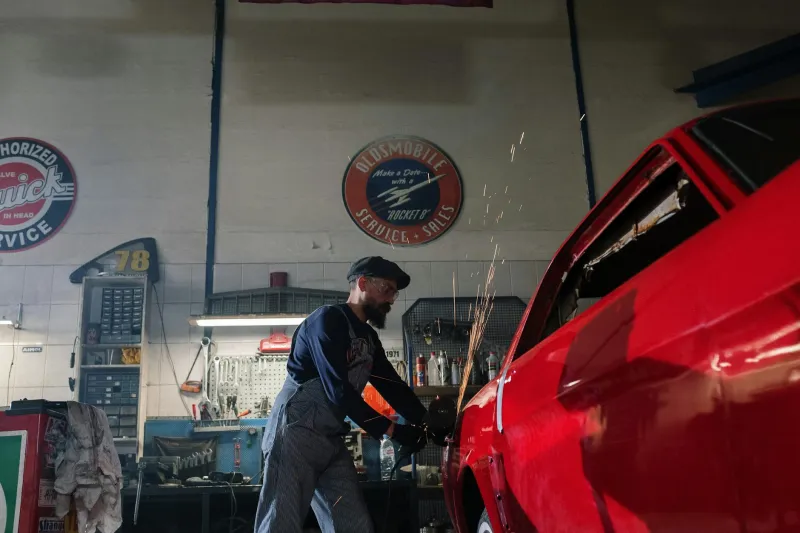
Walk into any auto service center today, and the first thing they'll do is plug your car into a computer. That'll be $150 to $200, please — just to find out what's wrong. No guarantees the diagnosis will be right, and no promises the fix will be affordable. But for most of the 20th century, American car repair worked completely differently.
The Corner Garage That Knew Your Family Car
Every neighborhood had one: the local mechanic who could diagnose your car's problem before you finished describing the symptoms. These weren't corporate technicians following computer prompts — they were craftsmen who learned engines through decades of hands-on experience.
Take Eddie's Garage on Maple Street, a fixture in countless American towns. Eddie knew that Mrs. Patterson's 1978 Buick made a particular clicking sound when the transmission was about to act up. He recognized the whine of Mr. Johnson's alternator from across the parking lot. When the high school kids brought in their beat-up Chevys, he could tell by the exhaust note whether they'd been racing again.
 Photo: Maple Street, via images.squarespace-cdn.com
This wasn't magic — it was expertise built over years of working on the same types of cars, often the same actual vehicles, in the same community. Eddie kept mental notes on every regular customer's car: when parts were last replaced, which repairs had been done, what problems typically developed next.
When Car Repair Was About Relationships, Not Computers
The old system ran on trust and personal relationships. If Eddie said your car needed a new water pump, you believed him because he'd been right about your last three cars. If money was tight, he might let you pay over a couple of months — he knew where you lived and worked.
Prices were straightforward: parts cost what they cost, and labor was charged by the hour at rates everyone in town knew. There were no "diagnostic fees" because diagnosis was part of the service, not a separate profit center. A good mechanic's reputation depended on fixing problems efficiently and honestly.
Most importantly, these mechanics had strong incentives to keep your car running as long as possible. In small communities, word traveled fast about shops that pushed unnecessary repairs or failed to fix problems correctly the first time.
The Rise of the $200 Guess
Today's automotive service industry operates on fundamentally different principles. Modern cars contain dozens of computer systems, each generating error codes that require specialized equipment to read. What used to be mechanical problems you could hear, see, or feel have become electronic mysteries buried in software.
The result? That $200 diagnostic fee has become standard across the industry. Shops invest tens of thousands of dollars in diagnostic equipment, then charge customers to recoup those costs — whether the diagnosis leads to an actual fix or not. Unlike the old days when a wrong guess cost the mechanic time and reputation, today's computerized diagnostics shift that risk to the customer.
Corporate chains and dealership service centers have largely replaced independent mechanics. These operations prioritize efficiency and profit margins over customer relationships. Service advisors often know nothing about engines — they're trained to sell services based on mileage intervals and computer recommendations, not actual vehicle condition.
What We Lost in Translation
The shift from mechanical expertise to computer diagnostics has created a fundamental disconnect between car owners and their vehicles. Where previous generations understood their cars well enough to spot developing problems, today's drivers are completely dependent on professional diagnosis for even minor issues.
This dependency comes at a steep price. The average American now spends over $1,200 annually on vehicle maintenance and repairs — nearly double what families spent in inflation-adjusted dollars during the 1980s. Much of that increase comes from diagnostic fees, software updates, and the complexity of modern automotive systems.
The personal relationships that once kept repair costs reasonable have largely disappeared. Today's service centers see customers as transactions, not neighbors. There's little incentive to build long-term relationships when corporate policies and profit targets drive decision-making.
The Hidden Cost of Progress
Modern cars are undeniably more reliable and efficient than their predecessors. Computer-controlled engines run cleaner, last longer, and deliver better fuel economy. But this technological progress has come with an unexpected cost: the end of affordable, relationship-based automotive care.
Where mechanical problems once had mechanical solutions that local experts could provide, today's issues often require specialized tools, software access, and manufacturer-specific training that only corporate service centers can afford to maintain.
The result is a automotive service industry that's more profitable than ever, but less accessible to ordinary Americans struggling with car repair costs. The neighborhood mechanic who could keep your car running on a handshake and a payment plan has been replaced by corporate systems designed to extract maximum revenue from every customer interaction.
That transformation represents more than just changes in automotive technology — it reflects a broader shift from community-based commerce to corporate-controlled markets. And for millions of American families, it's made one of life's essential services significantly more expensive and impersonal than it used to be.