The Car Used to Be the Great American Equalizer. Now Check the Price Tag.
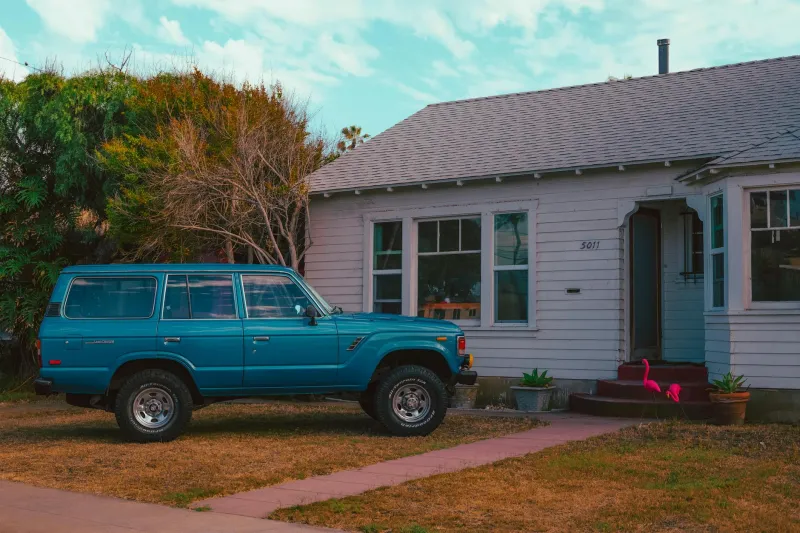
The Car Used to Be the Great American Equalizer. Now Check the Price Tag.
There's a photograph that captures something important about postwar America. It's the kind of image you've probably seen a version of: a family standing in a driveway, beaming, next to a gleaming new car. Brand new. Maybe a Ford, maybe a Chevy. The pride on their faces isn't about showing off. It's about arrival. About what was now possible.
For the generation that grew up during the Depression and came home from the war, a new car wasn't a luxury. It was proof that the system worked — that ordinary labor could buy something real and shining and yours.
That feeling was based on actual math. And the math, somewhere along the way, stopped working the same way.
When New Cars Were Actually Affordable
Let's go to the numbers, because they tell the story better than anything else.
In 1950, the average price of a new car in the United States was approximately $1,510. The median household income that year was around $3,300. That means the average new car cost roughly five to six months of household earnings.
By 1970, the average new car price had risen to about $3,500 — but median household income had climbed to around $9,800. The ratio held. A new car still cost somewhere between four and five months of typical household income.
Fast forward to today. The average transaction price for a new vehicle in the United States crossed $48,000 in 2023. Median household income sits at roughly $74,000. That's nearly eight months of household earnings — and that's the median price across all vehicles, including smaller, cheaper models. For trucks and SUVs, which now dominate American sales, the numbers run considerably higher.
The ratio didn't collapse all at once. It drifted, year by year, until the gap between what cars cost and what ordinary wages could absorb quietly became something different in kind, not just degree.
The Factory Worker Who Could Actually Afford the Thing He Built
There's a particular detail from the postwar era that doesn't get talked about enough: the workers building cars could often afford to buy them.
A unionized autoworker in Detroit in 1955 earned wages that, combined with overtime, could put him in a new vehicle without destroying his financial life. The UAW had negotiated wages and benefits that kept pace with productivity gains. Henry Ford's original logic — pay workers enough that they can buy what they make — had become, for a generation, something close to reality.
That dynamic created a virtuous loop. Workers earned enough to consume. Consumption drove demand. Demand sustained jobs. Jobs sustained wages. It wasn't perfect, and it certainly wasn't universal — Black workers and women were often shut out of the best-paying positions — but the general structure held for a significant slice of the American workforce.
Today, the average autoworker's wages, adjusted for inflation, have recovered somewhat after the 2019 UAW contract victories and the 2023 strike wins. But the broader picture of American wage growth versus vehicle price growth tells a less encouraging story. Real wages for non-supervisory workers have grown modestly since the 1970s. Real vehicle prices have grown substantially.
Why Cars Cost So Much More — And Whether That's the Whole Story
It would be unfair to frame this purely as a story of corporate greed or market failure, because that's not the complete picture.
Modern vehicles are genuinely more sophisticated than anything on the road in 1965. A base-model sedan today comes standard with features that would have been unimaginable on a luxury vehicle half a century ago: airbags, anti-lock brakes, backup cameras (now federally required), lane departure warnings, Bluetooth connectivity, fuel injection systems that optimize efficiency in real time. The safety improvements alone are staggering — traffic fatality rates per mile driven have fallen by roughly 80 percent since the early 1970s, and the engineering embedded in modern vehicles is a significant part of that.
Consumer expectations have also shifted. Americans largely stopped buying small, stripped-down economy cars. The market responded. When the bestselling vehicle in the country is the Ford F-150 — which now starts around $36,000 and can climb past $80,000 in higher trims — average transaction prices will reflect that.
But here's the thing: explaining why cars cost more doesn't resolve the affordability problem. A safer, smarter car that you can't comfortably pay for isn't a better deal just because the engineering is impressive.
The Loan That Stretched to Cover the Gap
The auto industry found a way to paper over the affordability gap, and it involves a number most buyers focus on more than the price itself: the monthly payment.
Average auto loan terms in the 1970s ran 36 months. Today, the average new car loan term is over 69 months — nearly six years. Loans of 84 months, seven full years, are increasingly common. Lenders have essentially stretched the debt across time to make the monthly number feel manageable, even as the total cost and interest paid have grown substantially.
The result is that millions of Americans are perpetually underwater on their vehicles — owing more than the car is worth — and cycling into new loans before the old ones are paid off. The car payment has become, for many households, a permanent fixture of the monthly budget rather than a temporary expense.
And this is before accounting for insurance, which has surged in recent years, or maintenance costs on increasingly complex vehicles that often require specialized equipment and trained technicians to service.
Freedom, Financed
The car was always more than transportation in America. It was independence. It was possibility. The open road, the long drive, the ability to go wherever you wanted without asking anyone's permission — that mythology was built on the fact that the car was actually, genuinely accessible to ordinary people.
That accessibility is now conditional in ways it wasn't before. Conditional on your credit score. Conditional on your willingness to carry debt for the better part of a decade. Conditional on a monthly payment that crowds out other spending in ways that the five-month purchase of 1955 simply didn't.
The car hasn't stopped being a symbol of American freedom. It's just quietly become a symbol that a lot of Americans are financing at 7 percent interest over 72 months.
The open road is still there. The math to reach it just got a lot more complicated.