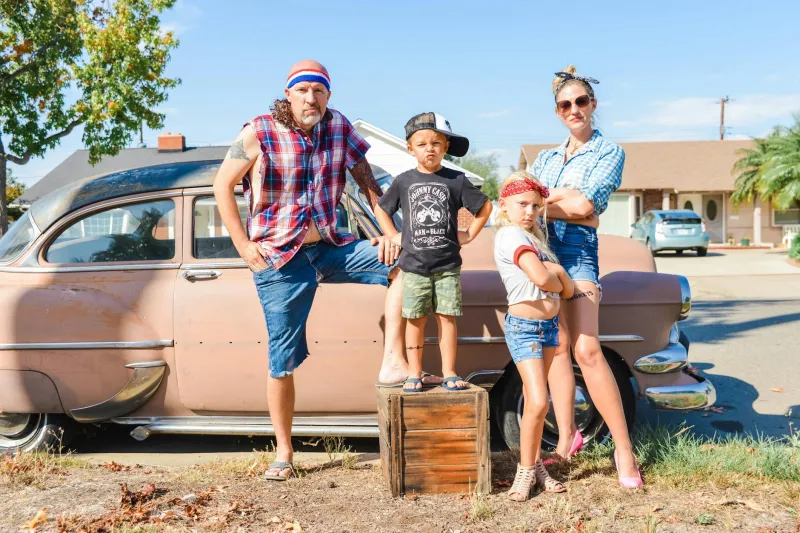
Somewhere in suburban America circa 1975, twelve-year-old Tommy Henderson was crouched next to Mrs. Rodriguez's Schwinn bicycle, his small hands working a wrench around the chain guard. The bike had been making a grinding noise for weeks, and Mrs. Rodriguez — knowing Tommy had a knack for mechanical things — flagged him down after school.
 Photo: Tommy Henderson, via lookaside.instagram.com
 Photo: Mrs. Rodriguez, via image.civitai.com
"Can you take a look at this thing?" she'd asked, wheeling the red Schwinn out of her garage.
Twenty minutes later, Tommy had the chain properly aligned and the brakes adjusted. Mrs. Rodriguez pressed a warm chocolate chip cookie into his hand and told him to come by Saturday — she'd have fresh tamales ready.
No money changed hands. No app was opened. No five-star rating was given. It was just neighbors helping neighbors, the way America used to work.
When Every Block Had Its Own Economy
Fifty years ago, American neighborhoods operated on what economists now call "gift economies" — informal networks where people traded skills, time, and favors without keeping strict financial tabs. These weren't just random acts of kindness; they were the backbone of how communities functioned.
Every street had its cast of characters: the retired machinist who could fix any small engine, the housewife who tailored clothes from her dining room table, the teenager who knew his way around a lawn mower, and the grandmother who babysat for anyone who asked nicely.
Consider what a typical suburban block offered in 1970:
- Engine tune-ups in Bob's garage (payment: a case of beer)
- Dress alterations by Helen (payment: watching her kids next Friday)
- Lawn care by the Morrison boy (payment: $3 plus lemonade)
- Dog walking by anyone heading that direction anyway (payment: nothing expected)
- Computer help from that college kid down the street (payment: a home-cooked meal)
This informal economy wasn't just about saving money — though families certainly did. It was about building relationships, sharing knowledge, and creating the social fabric that held neighborhoods together.
The Death of the Favor Bank
Today, that same bicycle repair costs $45 at the local shop, or you can book "Mike" through TaskRabbit for $35 plus fees. The dress alteration runs $25 through Seamster, an app that connects you with "vetted sewing professionals." The lawn gets mowed by a crew dispatched through LawnStarter for $60 per visit.
What happened?
First, liability fears crept in. Insurance companies and lawyers convinced Americans that informal help was a lawsuit waiting to happen. What if Tommy dropped that wrench on his foot? What if Helen's alterations ruined an expensive dress? The friendly neighborhood handyman became a potential legal nightmare.
Second, professionalization took over. Every skill that used to be casually shared became someone's certified specialty. Need a bike fixed? Better take it to a "professional bicycle technician." Want your grass cut? Only licensed, bonded, insured lawn care specialists need apply.
Third, mobility destroyed continuity. The average American moves 11 times in their lifetime now, compared to 5 times in 1970. It's hard to build a favor bank when you don't know your neighbors' names.
The App-ification of Everything
Enter the gig economy, which promised to recreate those neighborhood networks through technology. Need someone to walk your dog? There's an app for that. Want grocery shopping done? Another app. Looking for someone to assemble that IKEA bookshelf? Yet another app.
But something fundamental got lost in translation.
When Tommy fixed Mrs. Rodriguez's bike, he learned mechanical skills, built confidence, and earned social capital in his community. Mrs. Rodriguez got more than a repair — she got peace of mind knowing a reliable kid lived two doors down.
When you book "TaskRabbit Mike" to fix your bike, Mike gets $20 after the platform takes its cut. You get a bike repair from a stranger you'll likely never see again. The transaction ends when the job is done.
The True Cost of Convenience
The numbers tell a stark story. Americans now spend an average of $1,200 annually on services that previous generations handled through informal networks. That's lawn care, house cleaning, pet services, handyman work, and other tasks that neighbors once did for each other.
But the financial cost is just the beginning. When we outsourced neighborhood favors to gig platforms, we also outsourced the relationships that came with them.
Consider what disappeared:
- Skill sharing: Kids no longer learn by watching adults work
- Community bonds: Neighbors remain strangers instead of becoming friends
- Social safety nets: No one knows who to call when real emergencies strike
- Economic resilience: Families lost their informal support systems during tough times
The Isolation Tax
Social scientists have a term for what replaced America's favor economy: "the isolation tax." It's the premium we pay for living among strangers instead of neighbors.
When Mrs. Rodriguez needed her bike fixed in 1975, the solution lived two doors down and cost nothing. When her granddaughter needs the same service today, it requires downloading an app, creating a profile, entering payment information, scheduling availability, and paying market rates to a stranger.
The bike gets fixed either way. But only one version builds community.
What We Gained and Lost
To be fair, the gig economy solved real problems. Professional services are more reliable, accountable, and accessible than hoping your neighbor knows how to install a ceiling fan. Apps made it possible to find help in new cities, access specialized skills, and get assistance at odd hours.
But we traded depth for breadth, relationships for transactions, and community resilience for individual convenience.
Tommy Henderson, now in his sixties, recently hired someone through TaskRabbit to fix his grandson's bike. "I could have done it myself," he says, "but the kid lives three states away, and I don't know any twelve-year-olds in my neighborhood anymore."
The bike got fixed. But no one learned anything, no relationships were built, and no community was strengthened.
Somehow, that feels like the most expensive repair of all.