The Suit That Outlived Three Jobs
In 1965, Robert Mitchell walked into Goldstein & Sons on Main Street and did something that would seem impossible today: he spent an entire week's salary on a single piece of clothing. The charcoal gray wool suit cost him $185 — exactly what he earned in five days as a junior accountant at the local insurance company.
 Photo: Main Street, via mainstreetchickens.com
 Photo: Goldstein & Sons, via images.squarespace-cdn.com
 Photo: Robert Mitchell, via platform.coop
Fifty-eight years later, that same suit hangs in his closet, still perfectly wearable. It's been to hundreds of business meetings, dozens of weddings, and countless church services. The fabric remains rich, the tailoring still sharp. Robert estimates he's worn it over 500 times, making the cost per wear roughly 37 cents.
This wasn't unusual for his generation. It was simply how Americans approached clothing: as an investment in their future selves.
When Quality Had a Price Tag Everyone Understood
The economics of mid-century clothing operated on a completely different principle than today's fast fashion cycle. Americans expected to pay significant money for clothes, but they also expected those clothes to last for decades. The social contract was clear: higher upfront cost in exchange for years of reliable service.
A quality men's suit in 1965 typically cost between $150-250, representing roughly one week's wages for a middle-class worker. Women's coats followed similar economics — a well-made wool coat might cost $75-125, equivalent to several days' pay, but it was purchased with the expectation of wearing it for a decade or more.
Department stores supported this model by offering extensive alteration services and seasonal storage. Customers built relationships with sales associates who understood their style preferences and body measurements. The goal wasn't to sell as many items as possible, but to sell items that would keep customers satisfied for years.
The Ritual of Serious Shopping
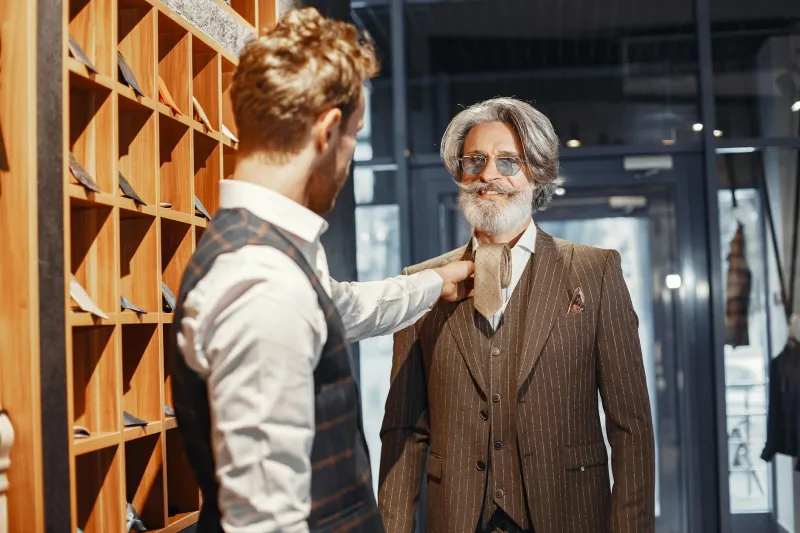
Buying clothes used to be an event. Families planned shopping trips to downtown department stores, often making a full day of it. Men would spend an hour or more being fitted for a suit, with multiple measurements, fabric discussions, and careful consideration of details like lapel width and trouser break.
Women's shopping involved similar deliberation. A good dress or coat was examined for fabric quality, construction details, and versatility. Sales associates were trained to help customers think through how a piece would work with their existing wardrobe and lifestyle needs.
Credit was available for major clothing purchases, but it worked differently than today's instant gratification model. Many stores offered layaway programs, where customers would pay incrementally over months while the store held their items. This forced a cooling-off period that eliminated impulse purchases and ensured that customers were committed to their choices.
The Wardrobe as Investment Portfolio
Middle-class Americans in the 1960s and 1970s typically owned far fewer clothes than today's consumers, but each piece served multiple purposes and lasted for years. A businessman might own three suits total — one navy, one gray, one brown — but each was well-made enough to look professional for a decade.
Women's wardrobes operated on similar principles of versatility and longevity. A quality blazer could dress up casual skirts or dress down formal dresses. A well-made handbag was expected to last for years and complement multiple outfits. The concept of "fast fashion" — buying trendy, disposable clothes — simply didn't exist.
This approach required Americans to think differently about style. Instead of following every trend, they focused on classic designs that wouldn't look dated. Instead of buying for specific occasions, they chose versatile pieces that could be styled multiple ways. The result was a more uniform but arguably more elegant approach to dressing.
When Mending Was Normal, Not Nostalgic
Clothing maintenance was a standard part of household management. Nearly every family had someone who could perform basic alterations, replace buttons, and mend small tears. Professional tailors and seamstresses maintained thriving businesses helping customers extend the life of their clothing investments.
Shoes were regularly resoled rather than replaced. Coats were relined when the interior wore out. Suits were altered as bodies changed over time. The idea of throwing away a piece of clothing because of minor damage would have seemed wasteful and financially irresponsible.
This maintenance culture was supported by the way clothes were constructed. Seams were finished properly, buttons were sewn securely, and fabrics were chosen for durability rather than just initial appearance. Manufacturers expected their products to be repaired and altered, so they built them to withstand multiple interventions.
The Fast Fashion Revolution
The transformation began in the 1980s and accelerated through the 1990s and 2000s. Global manufacturing, synthetic fabrics, and new retail models made it possible to produce clothing at unprecedented low costs. Suddenly, Americans could buy multiple outfits for the price of a single quality piece.
The value proposition shifted from cost-per-wear to immediate gratification. Why spend $200 on one suit when you could buy five suits for the same price? The fact that those five suits might last a total of two years while the expensive suit would last twenty became irrelevant in the face of variety and instant satisfaction.
Shopping transformed from a planned investment to recreational activity. "Retail therapy" entered the vocabulary as buying clothes became a form of entertainment rather than a practical necessity. The rise of credit cards made it easier to buy impulsively without considering long-term value.
What the Numbers Really Show
Today's Americans own roughly four times as many clothes as their grandparents did, but wear each item far fewer times. The average piece of clothing is worn just seven times before being discarded. A modern $30 dress worn seven times costs $4.29 per wear — more than ten times Robert's suit when adjusted for inflation.
The environmental and economic implications are staggering. Americans now discard over 80 pounds of textiles per person annually, most of which ends up in landfills. The constant cycle of buying and discarding has created a clothing budget that, for many families, exceeds what previous generations spent on their entire wardrobes.
Meanwhile, the infrastructure that supported quality clothing has largely disappeared. Most department stores no longer offer comprehensive alteration services. The neighborhood tailor has been replaced by dry cleaners who focus on cleaning rather than repairs. The knowledge of how to maintain and alter clothes has been lost in many families.
The Hidden Costs of Cheap Clothes
The shift to fast fashion has created costs that extend far beyond individual wardrobes. The constant pressure to produce clothes cheaply has driven manufacturing to countries with lower labor standards and environmental protections. The true cost of a $10 shirt includes environmental damage and labor exploitation that never appears on the price tag.
For consumers, the psychological impact has been significant. The satisfaction of owning something well-made and long-lasting has been replaced by the temporary high of frequent purchases. The confidence that came from wearing quality clothes has been undermined by the anxiety of keeping up with constantly changing trends.
Professionally, the change has been particularly notable. The business suit that once signaled serious investment in one's career has been replaced by a rotation of cheaper alternatives that may look good initially but quickly show wear. The message sent by clothing has shifted from "I invest in quality" to "I follow trends."
The Return to Quality
Some Americans are rediscovering the wisdom of their grandparents' approach to clothing. The "buy it for life" movement encourages consumers to research quality, pay higher upfront costs, and expect decades of use from their purchases. Vintage and consignment shopping has grown as people seek well-made pieces from earlier eras.
Small manufacturers are building businesses around the old model of quality and durability. These companies charge prices that seem shocking compared to fast fashion, but reasonable when compared to the cost-per-wear of well-made items. The challenge is convincing consumers to think beyond the immediate purchase price.
The lesson from Robert's 58-year-old suit isn't that everyone should spend a week's wages on clothing. It's that the relationship between cost, quality, and value has become disconnected in ways that ultimately serve no one well. In a world of endless choice and instant gratification, the simple wisdom of buying less but buying better has never been more relevant.