The Man Behind the Counter Who Knew Everything
Walk into Murphy's Hardware in 1975, and within thirty seconds, old Pete behind the counter would diagnose your plumbing problem, recommend the exact part you needed, and throw in a story about how he'd fixed the same issue at your neighbor's house last month. The entire transaction — problem solved, part purchased, installation tips included — took less time than finding a parking spot at today's Home Depot.
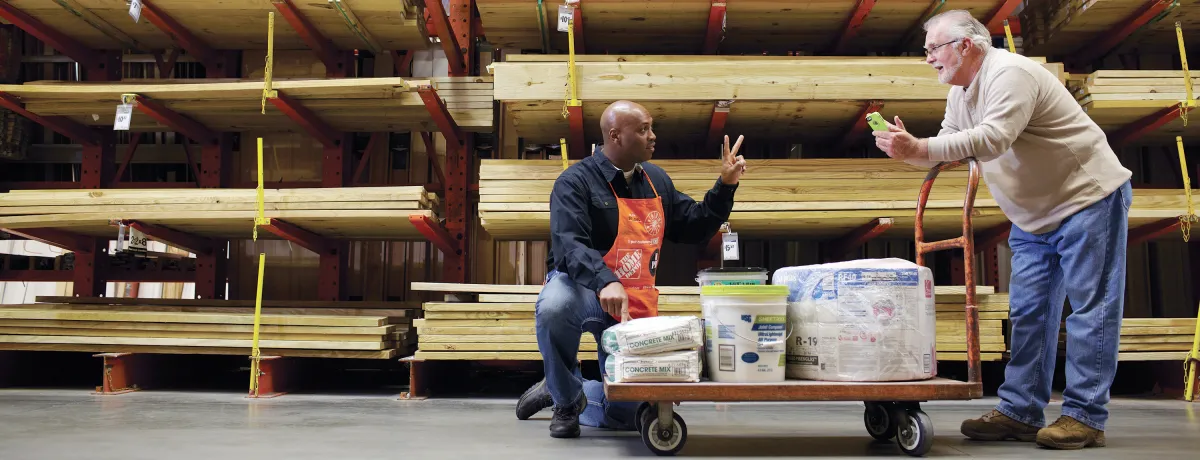 Photo: Home Depot, via corporate.homedepot.com
These weren't just stores. They were America's distributed network of practical knowledge, staffed by people who'd spent decades learning the difference between a 3/8-inch lag bolt and a carriage bolt, and more importantly, which one would actually hold your deck railing together through a Minnesota winter.
When Shopping Meant Talking, Not Wandering
The old hardware store model operated on a completely different economic principle than today's big-box retailers. Instead of maximizing inventory turnover and minimizing labor costs, these shops maximized problem-solving capability. The guy behind the counter wasn't there to process transactions — he was there to prevent you from making the same mistake twice.
Customers didn't browse endless aisles hoping to stumble across the right widget. They described their problem, and the store owner walked directly to the solution. No scanning barcodes, no searching through 47 different screw types, no wondering if this particular drain snake would actually fit your particular drain.
This efficiency had real economic value. A ten-minute conversation with Pete could save you three trips to different stores, two returned items, and one emergency plumber call. The markup on that specialty washer might have been 200%, but it was still cheaper than the alternative.
The Economics of Expertise
Here's what made the old system work: hardware store owners were essentially selling their knowledge, with physical products as the delivery mechanism. They could afford to stock 10,000 different fasteners because they knew exactly when each one was needed. They could maintain razor-thin profit margins on common items because they made their real money solving the weird problems that sent customers to three other stores first.
Modern big-box retailers flipped this model completely. They sell products efficiently but treat knowledge as an expensive overhead to minimize. The result is stores with 100,000 square feet of inventory staffed by part-time workers who genuinely don't know the difference between a Robertson screw and a Phillips head.
This shift represents one of the most dramatic changes in American retail economics. We traded expertise for selection, personal service for lower prices, and community knowledge for corporate efficiency.
What $47 Billion in Market Cap Actually Costs
Home Depot's business model is undeniably successful — the company generated $157 billion in revenue last year. But that success came at the cost of something harder to quantify: the elimination of thousands of small business owners who understood their local communities' specific needs.
In 1975, if your 1920s house had some weird pipe fitting that didn't match modern standards, your neighborhood hardware guy probably had the adapter you needed in a dusty box somewhere. He'd been dealing with that exact problem for twenty years. Today, you'll spend forty minutes wandering through a warehouse-sized store, eventually give up, and order something online that may or may not work.
The financial impact of this change shows up in ways most people never calculate. Modern homeowners make significantly more return trips to hardware stores, buy more wrong parts, and hire professionals for jobs that previous generations handled themselves with proper guidance.
The Knowledge That Walked Out the Door
When the last independent hardware stores closed, America lost more than just businesses — we lost institutional memory. These shop owners were walking encyclopedias of practical knowledge accumulated over decades of solving real problems for real people.
They knew which brands actually lasted, which shortcuts worked and which ones created bigger problems, and how to fix things in ways that weren't necessarily in any manual but definitely worked. This knowledge wasn't written down anywhere. It lived in conversations, in the relationship between a store owner and his community.
Today's home improvement culture reflects this loss. YouTube tutorials and online forums try to fill the gap, but they can't replicate the personalized advice that came from someone who'd seen your specific problem a hundred times before.
The Price of Scale
The irony is that modern consumers often spend more money and time solving simple problems than their predecessors did. A $3 conversation with Pete might have prevented a $300 mistake, but Pete's store couldn't compete with a corporation that could sell screws for half the price by buying them by the million.
We gained enormous selection and lower prices on individual items. We lost the kind of personalized expertise that prevented us from needing to buy the wrong items in the first place. It's a trade-off that made perfect sense from a corporate efficiency standpoint but ignored the real value that local knowledge provided to communities.
The neighborhood hardware store represented something that modern retail has never quite figured out how to replicate: the economic value of genuine expertise delivered through personal relationships. In our rush toward efficiency and scale, we may have optimized away one of the most useful forms of American small business.